I just finished reading a new book about AI agents. An actual book — cover to cover. I was born in the early 80s and we are wired that way. We read books. We do not watch a 7-minute YouTube summary and call it research. Give me pages, give me chapters, give me something I can hold.
The irony is not lost on me. By the time I finished the last chapter, at least two things in it were probably already obsolete. That is just where we are with this technology — it moves faster than print. But the fundamentals hold, and the fundamentals are what I want to talk about today. Because if you are a business owner trying to make sense of AI agents beyond the noise and the sales pitches, the fundamentals are exactly what you need.
What an AI agent actually is
The simplest way I can put it: a regular AI tool answers you. An AI agent acts for you.
When you open ChatGPT and type a question, you get a response. That response might be very good. But you are still the one who has to do something with it — copy it, adjust it, paste it somewhere, apply it. The AI helped you think. You still did the work.
An AI agent removes that gap. You describe what you want done. The agent figures out the steps, uses the tools it has access to — websites, files, emails, your software — and gets it done. You come back to a completed task, not a suggested approach.
Here is a quick example. You want to know what three of your competitors recently changed on their pricing pages.
With regular AI: it tells you what it knows as of its last training cutoff — which could be months ago. Not always useful.
With an AI agent: it visits the pages, reads them, notes the changes, and hands you a summary. Fresh. Done. You never touched a browser.
What it looks like in practice
Let me give you two examples that are running in the real world today — nothing experimental, nothing sci-fi.
You are hiring. Resumes come in. Normally someone reads them, scores them against your criteria, shortlists the good ones, and puts them in front of you. That person is often you. It takes a few hours every time you open a role.
An AI agent handles it like this: it reads each resume, scores candidates against the criteria you gave it, flags the ones worth your time, and writes a short summary of each. You open your inbox and find four shortlisted candidates with notes. The other 50 never crossed your desk.
Second example. You want to follow up with customers who have gone quiet in the last 30 days. Normally someone pulls the list, drafts the emails, personalizes them, and sends them. Half the time it does not happen because everyone is too busy.
An agent checks your CRM, identifies the dormant contacts, writes follow-ups based on their last interaction, and either sends them or queues them for your review. Every 30 days. Without being reminded. Without forgetting.
The value is not that AI is smarter than your team. The value is that it does not have a full calendar, a bad day, or a reason to deprioritize the task you asked it to handle.
Agents vs. workflows — the actual difference
I wrote about AI workflows a while back — worth reading if you haven't — and I want to be precise about the difference because people conflate them and it leads to the wrong expectations.
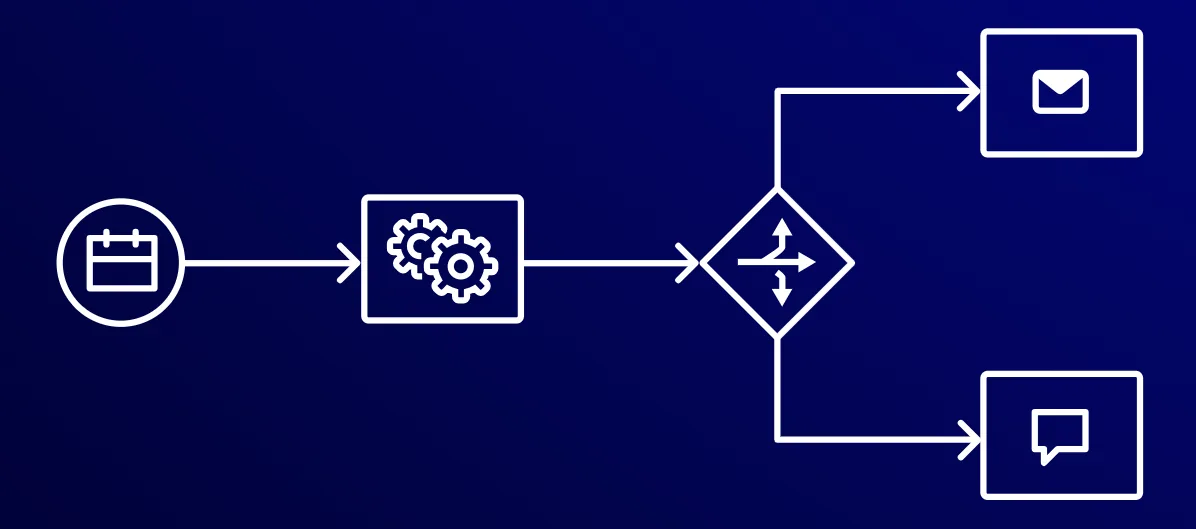
A workflow follows a fixed path. You define step A, step B, step C. Something triggers it, it runs in order, a result comes out. Consistent, reliable, and predictable — as long as the inputs are what you expected. The moment something unusual happens, it either fails or flags a human.
An agent figures out the path. You give it a goal. It decides how to get there. It can try something, evaluate the result, and adjust. It handles situations that a rigid workflow would choke on.
Think of it this way. A workflow is a well-trained employee with a checklist — they do the same thing every time, efficiently and without variation. An agent is more like a smart junior analyst — you describe the outcome you want, not the steps, and they figure it out.
Should your business care right now?
Honestly — it depends on where you are.
If you are still running most of your operations manually, agents are not your next move. There is a sequence to this. Get your repetitive, predictable tasks automated first. Once those are running well, you will see clearly where agents make sense — the tasks that are too unpredictable for a simple workflow but still do not require a full-time person making judgment calls.
If you are already automating parts of your business and hitting the ceiling of what a fixed workflow can do, that is exactly where this conversation gets interesting.
The technology is real. It is not magic. The simpler use cases — research, screening, follow-ups, scheduling, data processing — are production-ready today. The more complex ones need careful design, clear boundaries, and a human in the loop for anything that matters. Anyone selling you a fully autonomous AI agent that runs your entire operation with zero oversight is either confused or hoping you are.
But the direction is clear. AI agents are not a future thing. They are a now thing — applied carefully, in the right places, by businesses that have done the work to understand what they are actually asking for.