I've walked into a lot of Lebanese businesses over the years. Trading companies, distributors, manufacturers, retail chains. And almost all of them run on the same three systems: Excel, WhatsApp, and one person who knows where everything is. You know the one. Remove them for two weeks and the business half-stops while everyone else tries to reconstruct what was in their head.
When I bring up ERP, the reaction is usually one of three things: "that's for big companies," "we looked at it once and it was too expensive," or a blank stare. All three tell the same story — ERP has a perception problem in Lebanon that has nothing to do with whether it actually works. It does work. And most businesses that aren't using it are paying for that gap every month without realizing it.
What ERP actually is
ERP stands for Enterprise Resource Planning. Ignore the name — "enterprise" makes it sound like something only SAP sells to banks, which is where the confusion starts.
At its core, an ERP system connects the parts of a business that typically operate in isolation. Inventory talks to purchasing. Sales talks to inventory. Accounting updates the moment a sale closes or a delivery lands. Nobody copies numbers from one spreadsheet to another. Nobody sends a WhatsApp message to check if something is in stock. Nobody waits until end of month to understand where the cash actually stands.
One system. One version of what's true. Accessible to everyone in the business who needs it.
That's the whole idea. A corner shop managing ten product lines has the same fundamental need as a distribution company moving a thousand SKUs. The scale is different. The problem — disconnected data, manual reconciliation, decisions made on guesswork — is identical.
What it does for a business
The practical impact is real and it shows up fast. Here's where businesses feel it most:
You can see what's actually happening — in real time
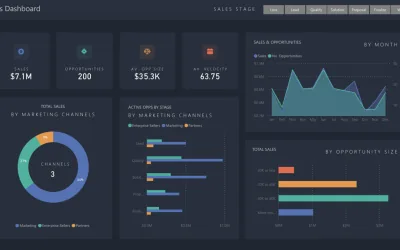
With ERP, a business owner can check inventory levels, outstanding invoices, sales figures, and cash position without calling anyone or waiting for a report. Most Lebanese business owners I talk to make decisions on gut feel not because they're careless — but because the data either doesn't exist in a usable form or takes days to compile. That changes immediately when everything feeds into one system. The first time a client gets a live dashboard of their actual numbers, the conversation shifts completely.
Data gets entered once and goes everywhere it needs to
In a disconnected business, the same information gets entered multiple times — once in the sales record, once in the inventory sheet, once in the accounting file. Every transfer is a chance for error, and errors compound. ERP eliminates the transfers entirely. Data entered at the source flows automatically to wherever it's needed. This alone saves hours every week across most businesses we've worked with.
Processes stop living in people's heads
ERP encodes how the business is supposed to work. A purchase order needs approval before it goes out. A delivery requires a signed receipt before inventory updates. A return requires a documented reason. This isn't bureaucracy — it's the difference between a business that runs consistently and one that runs differently depending on who's in the office that day. When processes exist only as institutional memory, they walk out the door with every employee who leaves.
Every transaction has a full audit trail
Every action in an ERP system is logged: who did it, when, and from what. Most businesses don't appreciate this until they need it — and when they need it, they really need it. A disputed invoice. A stock discrepancy nobody can explain. An accounting entry that doesn't match the delivery record. Without a system, you're searching WhatsApp history and hoping someone remembers. With one, you pull up the log in thirty seconds.
The hidden cost of not having one
This is the part that surprises people most. Business owners who look at ERP pricing compare it to zero — the apparent cost of the spreadsheets they're already using. The spreadsheets are not free.
Someone on the team spends hours every week reconciling data between systems that don't connect. Inventory counts are always a few days behind, so purchasing decisions get made on information that's already wrong. Invoices get duplicated. Stock gets ordered twice. A customer gets a delivery date that couldn't be met because the person who quoted it didn't know the warehouse situation. I've seen all of these in the same business, in the same month.
These aren't edge cases. They're the normal operating cost of a disconnected business. The cost is real — it just isn't labeled as such. It's buried in corrected mistakes, wasted staff hours, and decisions made on stale data.
The spreadsheet is not free. It's paid for in staff hours, in errors, in decisions made on stale information — and in the ceiling it puts on how large a business can grow before it collapses under its own complexity.
There's another cost that's harder to put a number on: key-person dependency. When the person who holds everything in their head takes a two-week vacation, the business pays. When they resign, the business pays more. ERP moves that knowledge out of one person's head and into a system everyone can use. That's not a nice-to-have. For a growing business, it's structural.
Why Lebanon lags behind
ERP adoption in Lebanon is significantly lower than in comparable regional markets — Jordan, Egypt, the Gulf — and this was true long before any recent economic difficulties. A few things explain it.
The word "enterprise" did real damage
Lebanese business owners who encountered ERP ten or fifteen years ago remember SAP and Oracle — systems that cost six figures to license and required a year-long implementation project. Those numbers were real. The problem is that the perception stuck while the market moved on entirely. The ERP platforms available today bear almost no resemblance to those implementations in terms of cost or complexity. But the word "enterprise" still triggers the old reflex: "that's not for us."
Early implementations went badly
The ERP systems that did reach Lebanon were often poorly adapted to the local market. Arabic language support was minimal. Dual-currency handling — essential in a market where most businesses deal simultaneously in USD and LBP — was clumsy or missing entirely. Implementations were frequently misconfigured by partners who didn't understand the local context. Those failures became cautionary tales. The software got blamed for what was really a localization and implementation problem.
There was no local expertise to turn to
A successful ERP implementation isn't just installing software. It requires someone who understands your business processes, knows how to configure the system correctly for your specific operations, can train your team properly, and will be there when something breaks six months later. In mature markets, certified implementation partners exist in abundance. In Lebanon, that ecosystem was nearly nonexistent for years. Businesses that looked into it found no one they trusted locally, and international consultants priced for international markets.
Informal operations are deeply ingrained
Many Lebanese businesses — especially family-run ones — have operated informally for decades. Processes live in people's heads. Records exist primarily to satisfy the tax authority. Implementing ERP means formalizing how the business actually works, which is harder than installing software. It requires people to agree on what the process should be before the system can enforce it. That's a genuine organizational challenge, and it meets genuine resistance — especially when "the old way" has worked well enough for thirty years.
What has changed
The arguments against ERP that were reasonable in 2005 don't hold anymore. Several things have shifted significantly.
Modern ERP runs in a browser
No server to buy, no IT team to maintain it, no version upgrade projects to schedule. A business can go live on a complete ERP system today for a monthly subscription that costs less than a junior employee's salary. The capital expenditure barrier that justified avoiding ERP for years is gone.
Open source changed the cost equation entirely
Platforms like Odoo and ERPNext are built on open-source cores. Accounting, inventory, purchasing, sales, HR — the full suite — for the cost of implementation and configuration, not for enterprise license fees. For a small business, the software itself is effectively free. You pay for someone to set it up correctly and train your team. That's a fundamentally different conversation than "here's a $50,000 annual license."
Localization has caught up
Odoo today has mature Arabic language support, proper right-to-left interface handling, multi-currency management that handles USD/LBP correctly, and Lebanese tax configurations built in. The localization gaps that made earlier implementations painful have largely been closed. An implementation today doesn't require custom workarounds for requirements that should be standard.
Local implementation expertise now exists
The partner ecosystem in Lebanon is still thinner than it should be relative to the Gulf, but it exists now. There are teams with real Odoo experience who work in Arabic and understand how Lebanese businesses actually operate. That wasn't true five years ago. Getting a quality implementation no longer requires flying someone in from Beirut's international consultants at international rates.
Is ERP right for your business?
Not every business needs a full ERP implementation immediately. But in my experience, most Lebanese businesses with more than five or six employees are already past the point where their current systems are genuinely serving them. A few honest questions worth sitting with:
- Do you know your exact inventory position right now, without calling anyone? If not, that's an inventory visibility problem — and it's costing you in over-ordering, stockouts, and wrong delivery promises.
- Does your monthly accounting close take more than three days? If your team spends a week reconciling the books each month, that's an integration problem. The data exists; it's just scattered across too many places.
- Could you replace your most important operational person tomorrow without losing weeks of institutional knowledge? If the answer is no, you're one resignation away from a serious operational problem.
- Have you lost a contract or a financing opportunity because you couldn't produce clean, auditable financial records quickly? That opportunity cost is real — and it's larger than any ERP implementation would have cost.
You don't have to do everything at once. The businesses that implement ERP most successfully usually start focused: inventory and purchasing first, then accounting, then sales management. Get the most painful problem under control, prove the system to your team, then expand. A phased approach reduces risk and builds internal confidence in the new system.
The tools exist. The costs are manageable. Local expertise is available. For most Lebanese businesses, the only thing standing between where they are and a properly connected operation is the decision to start.