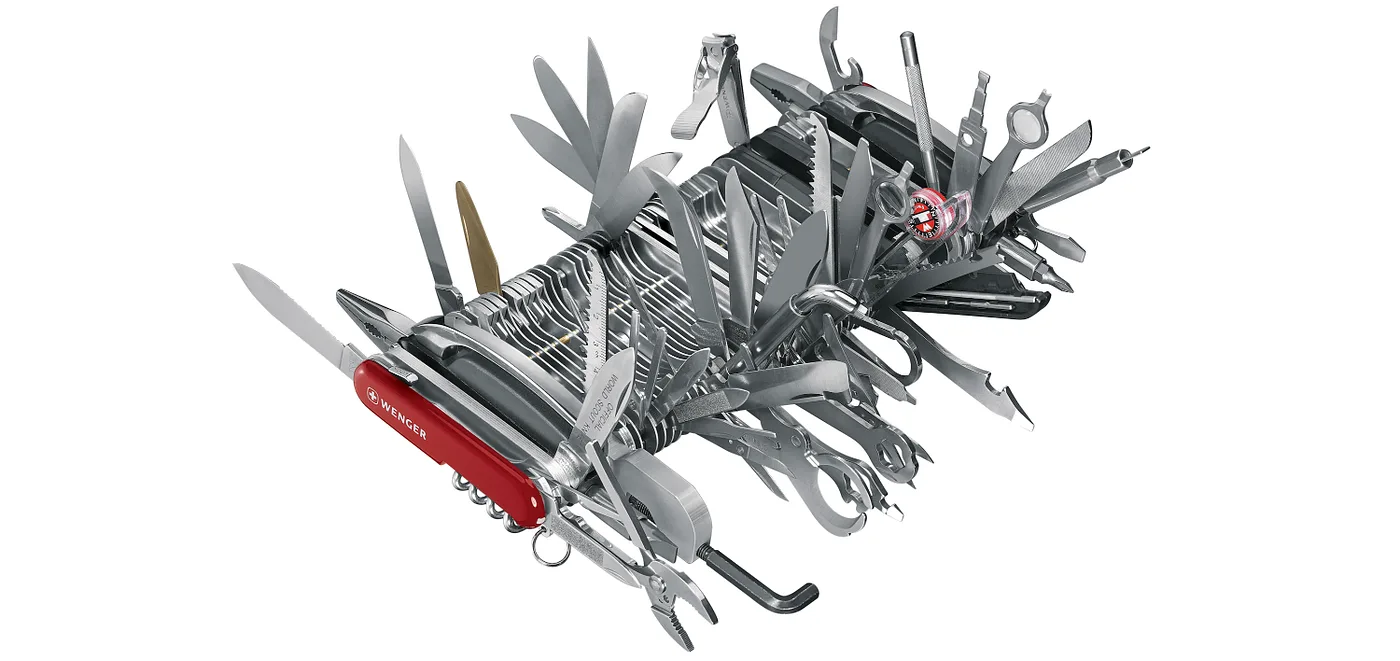
Someone built a Swiss army knife with 87 tools. Every blade, scissors, screwdriver, and whatever-that-other-thing-is, all deployed at once. It looks impressive. It is completely useless. You cannot grip it. You cannot use any individual tool without fighting the other 86.
That's a Claude Code session in 2026.
Open any AI coding agent framework and count the agents. There's a planning agent. A task decomposition agent. An architecture agent. A design agent. A code-writing agent. A code-review agent. A testing agent. A documentation agent. A verification agent. An orchestration agent that manages the other orchestration agents. Some of these spawn sub-agents. The sub-agents have skill sets. The skill sets have hundreds of entries. The framework does work — some of it, some of the time. But the complexity is not the feature. It's the habit.
This isn't new
Developers have been doing this long before AI tools gave them new surfaces to decorate.
The startup with four developers that built a microservices architecture with 14 services, a message queue, an API gateway, and a service mesh. For a CRUD app. The system took three weeks to run locally. It never scaled past 200 users because they ran out of runway first.
The internal tool built with GraphQL, Redis caching, event sourcing, and CQRS — because the team had just read about it. The tool was a read-only dashboard used by six people once a week.
The "simple" background job that became a distributed task queue with retry logic, dead-letter queues, priority lanes, and a monitoring dashboard. The job ran every night and sent one email.
These are not cautionary tales from bad developers. They're from teams that were genuinely trying to do good work. The over-engineering came from the same place it always does: the belief that complexity signals competence.
It doesn't.
Why developers do this
Simple code is hard to justify. If you build a REST endpoint that reads from a database and returns JSON, nobody can tell if you're senior or junior — it's just a handler. If you build a distributed event-driven system with CQRS and eventual consistency, you're clearly a serious engineer who has thought deeply about scalability.
Except you haven't. You've chosen the hardest solution to a problem that didn't require it.
There's also the boredom problem. Senior developers get bored doing simple things. Building an API for the fifth time this year is not intellectually interesting. Building an event-driven multi-agent orchestration framework with dynamic skill injection is at least fun. The problem is that you're billing someone else for your entertainment — and they'll be the ones debugging it at 2am six months later.
What it costs
The obvious costs: build time, debugging time, onboarding time. A system with 14 moving parts takes longer to understand than one with 3. Every abstraction layer is a tax on every future developer who touches it.
The real cost is velocity. Over-engineered systems become rigid quickly. You wanted flexibility, so you added abstraction. Now every small change requires touching five layers. A one-hour feature takes a day because of the ceremony the architecture demands. The thing you built to go faster is making you slow.
And then there's the maintenance cost nobody calculates upfront: cognitive load. A simple system lets you move fast six months later because you can hold it in your head. A complex one requires you to rediscover how it works every time you open it. That's not a small cost. It compounds.
Every line of code you don't write is a line that never needs to be debugged, maintained, or explained to the next developer who inherits it.
The question that fixes it
Before you add the extra layer, the extra service, the extra abstraction — ask: "Is this complexity solving a problem I have right now, or a problem I might have someday?"
If the answer is someday, delete it. You don't know what someday looks like. You don't know what the actual bottleneck will be. What you do know is that you're making this system harder to understand today for a benefit you may never need.
The AI agent frameworks will keep getting more elaborate. The skill sets will keep growing. The orchestration layers will multiply. None of that means you need all of it. A well-aimed question and a single API call will outperform a six-agent pipeline most of the time — and when it doesn't, you'll know exactly why, because the system is small enough to reason about.
Simple is a choice. A harder choice than complex, because it forces you to actually understand the problem instead of burying it in infrastructure.