I recently met the owner of a local company in Lebanon. He wasn't upset about one bill. He was upset about all of them together. A CRM, a ticketing system, a project and task manager, online invoicing, a sales system, and a few VPS servers hosting the tools they run themselves. Most of them charge per user, per month, in dollars.
He put it in a way I keep thinking about: you can't buy software anymore. Nothing is a one-time payment. You rent everything, forever, and the rent only goes up. Then he told me what he actually wanted. The company has a decent server sitting in the office, used as a backup machine. His wish was to cancel everything and let AI agents do the work instead.
Most consultants would smile politely and change the subject. I didn't say yes on the spot either. We sat together for several hours over several meetings, going through every tool, what it does, and what they actually use from it. Then I came back with a plan.
The bill nobody planned for
Nobody sits down and decides to spend $3,000 a month on software. It happens one tool at a time. Each subscription looked cheap when it was added. Then the team grew, every new hire became another seat on five different invoices, and the VPS servers kept multiplying because every self-hosted system wanted its own.
By the time we met, his rough estimate was around $3,000 a month, servers included. That's $36,000 a year, every year, for the right to keep using tools the company doesn't own. For a Lebanese business that rebuilt itself after 2019 and watched every dollar since, that number hurts.
Per-user pricing is a tax on growth. Every person you hire makes your software more expensive.
For every tool, the useful question was never "what can this software do?" It was "what does this company actually do with it?" Those are very different lists. The first one sells subscriptions. The second one is what you have to rebuild.
The plan
The plan cancels every subscription. All of them. The day-to-day results have to stay the same: tickets still get handled, invoices still go out, projects still get tracked, sales still get followed up.
What surprised the owner was that most of it doesn't need AI at all. The plan has four parts, and picking the right one for each job is most of the work.
Open-source tools where people need a screen
Some tools don't disappear. They get swapped. People still need a place to open a ticket, look at a project board or check a client's history, and AI is not a replacement for a screen. For those, the plan uses mature open-source tools, self-hosted on the same server. No license, no per-user fee. The difference is that the team stops doing the data entry. The automation fills the records in, and people look at the results and make decisions.
Traditional workflows, no AI
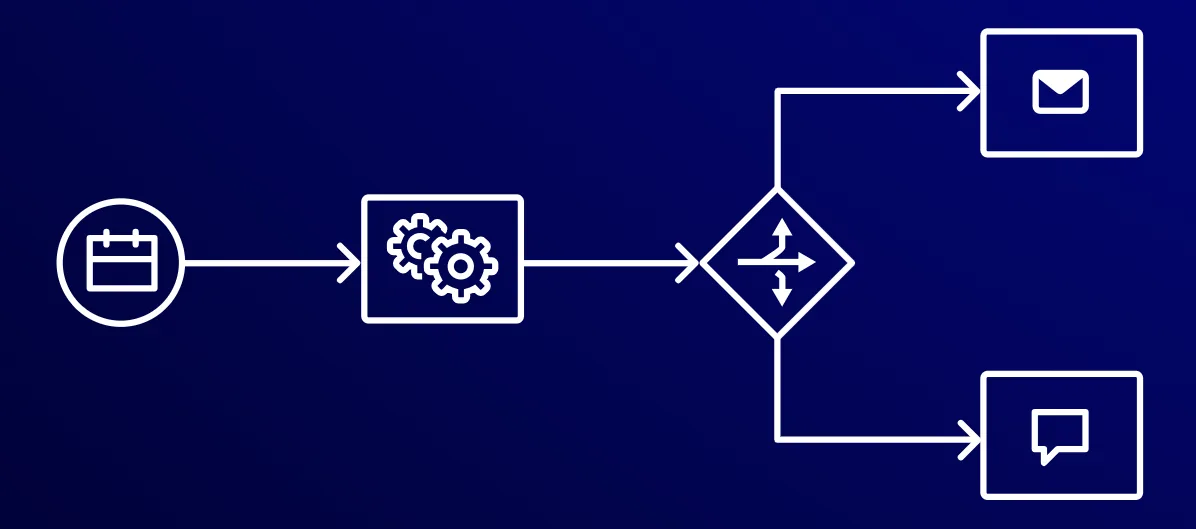
A lot of what those tools did is plain logic. Move this record there, send this reminder on this date, generate this report every Monday. That's handled by Python scripts, scheduled and managed by n8n. If a rule can be written as an if-statement, it doesn't need a brain. It needs a script that runs on time.
AI workflows
Some steps need to understand text. An email comes in and someone has to read it, figure out what it's about, pull out the client and the request, and log it in the right place. An AI workflow runs the same fixed steps every time, with the language model handling only the reading and writing part.
AI agents
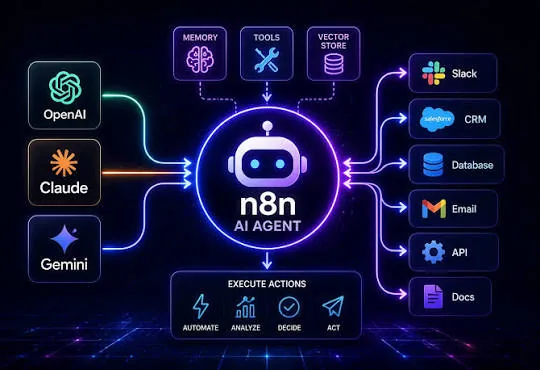
A smaller set of tasks needs judgment: looking things up across several records, deciding what's relevant, and putting together an answer or a draft. That's where AI agents come in. They get a limited set of tools, mostly reading from and writing to the company database, and nothing else.
n8n sits on top as the conductor. It feeds the open-source tools, runs the scripts, triggers the workflows, calls the agents, and keeps a log of what happened. Everything runs on the server they already own.
That conductor also gives them something they never had before. Five separate tools meant five separate databases, and any question that crossed two of them meant opening two tabs and doing the matching by hand. Now the automation sits as one layer above all the databases and links them together. Ask which clients have open tickets and unpaid invoices at the same time, and the answer comes back in one place. Nobody has to jump between tools to find out what's going on in their own company.
Why a local model is enough
The plan runs a language model locally on their office server. No OpenAI bill, no Claude bill, no per-token pricing. Replacing five subscriptions with a sixth one would have been a strange way to save money.
Let me be honest: local models are weaker than the big cloud models. If you want one to write your annual strategy, you'll be disappointed. But that's not the job here. Most of what these agents do is read something, write it to the database, and fetch it back later. You don't need a PhD to file folders. You need someone reliable who shows up every day and doesn't complain about the coffee.
There's a bonus. The company's data never leaves the building. No customer list sitting on someone else's server, no question about who is training on what. I wrote about why that matters in The AI Doesn't Need to Know Who Your Customers Are.
What would make it fail
Moving everything in-house moves the risk in-house too. A plan that ignores that is a sales pitch, not a plan. Three things had to be solved before I'd recommend it.
The backup server stops being a backup
Their spare server is about to become the most important machine in the company. So who backs it up? The answer is a NAS dedicated to database backups. If the main server dies, the data survives, and the company is back running from the last backup instead of starting from zero.
Power, because this is Lebanon
When your tools live in the cloud, a power cut in the office is an inconvenience. When everything runs in the office, a power cut is a company outage. Anyone who has lived here knows the moment when both the state power and the generator go quiet at the same time. The plan includes a strong, reliable UPS that can keep the office running for hours, not minutes.
The model needs a tune-up
Businesses change. New products, new clients, new ways of describing the same problem. Every three months or so, the internal prompts and instructions need adjusting so the agents keep doing exactly what they're supposed to do. It's a few hours of work, not a monthly bill, but it's real and I'd rather say it now.
The honest cost calculation
Before: around $3,000 a month, rising with every hire and every price update.
After: a one-time build, a NAS, a UPS, and a tune-up every quarter. The server is already paid for. Nothing is charged per user, so hiring the next employee costs a salary, not a salary plus five more seats.
None of this is free. But none of it grows on its own, and that's the whole point. The owner wasn't asking for cheaper subscriptions. He was asking to stop renting his own operations.
A quick honest aside. We're an Odoo partner, and Odoo charges per user per month. I'm not against subscriptions. If your team uses a tool deeply every day and it pays for itself, keep paying. This company had no ERP. It had five separate systems, each charging a monthly fee and none of them talking to the others. That's a different situation, and it called for a different answer.
Should you do this?
Maybe. Answer these first:
- Do you know your real yearly software cost? Monthly price times users times twelve, for every tool, servers included. Most owners are surprised by the total.
- What do you actually use from each tool? If it's most of the features, keep the tool. If it's a small slice, that slice can usually be rebuilt.
- Do you have a server, or are you willing to own one? This plan works because the hardware was already there.
- Can your office survive a power cut? If not, fix that before anything moves in-house.
- Who owns it inside the company? Someone has to notice when an agent starts doing something odd, and call before it becomes a habit.
This one is still a plan. When it's running, I'll write the follow-up, including whatever didn't go the way we expected.